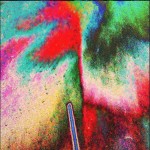
Far Wide Radio translates telescope data into sound. Each programme works from a single James Webb Space Telescope (JWST) or Dark Energy Spectroscopic Instrument (DESI) spectral cube, read directly by custom-made algorithms — no illustration, no mood music laid over a picture.
Four instruments make the series.
A batch engine sonifies a chosen field of the data — brightness, gradient, boundary, obstruction, lines, flow, holonomy, anisotropy — on a fixed bench: image row becomes pitch, column becomes stereo position, wavelength becomes time. Sometimes these are rendered clean of the continuum the telescope sends with the signal; sometimes it is kept, for its harmonic effect.
A spectral voice inverts that bench: wavelength becomes pitch rather than time, flux becomes loudness, and redshift becomes a downward transposition — so the further back the light comes from, the lower it falls.
A sheaves-based motif finder selects passages by the rarity and uniqueness of their structure.
And a live deck, built for this work, traverses a cube under hand control, voiced through a chosen lens. A lens decides two things at once: which feature of the data drives pitch, and what tuning the result snaps to. The deck carries twenty-six, from ordinary twelve-tone scales to non-Western, non-octave and microtonal systems.
Before Birth is voiced aggressively: a five-note pentatonic anchors the drone while a second voice runs deliberately unsnapped against it, so the tuning is never quite settled. It is the first series, and openly a test — long-form, unhurried, and in places completely silent. The silence is not an error. Where the data has nothing to report, nothing sounds.